Blog
Insights
APV (Workplace Assessment) Requirements and a Modern Digital Approach
Learn APV requirements in Denmark (workplace assessment): legal rules, physical and psychosocial risks, action plans, follow-up—and how digital APV improves compliance.

Benjamiin Laudrup
CEO & Co-founder — Leadership, Psychology & Coaching
Jan 12, 2026

APV (Workplace Assessment): Requirements and a Modern Digital Approach
In Denmark, APV is not “nice to have.” It is a legal requirement for virtually every workplace with employees, and it is one of the most practical tools for preventing injuries, reducing sickness absence, and improving daily working conditions. APV stands for Arbejdspladsvurdering—a workplace assessment (often translated as a workplace health and safety risk assessment). In English contexts you may also see WPA used as shorthand for workplace assessment.
Many organizations treat APV like an administrative task: something to complete every three years and store in a folder. But that mindset leaves value on the table—and it increases risk. The Danish rules are designed to make APV a living process: identify and assess risks, connect them to sickness absence, define actions with responsibility and deadlines, and follow up to confirm improvements.
This article explains how APV works in Denmark, what the law requires, how the physical and psychosocial work environment fit into the process, and how a modern digital approach can make APV more effective, more credible, and easier to run consistently.
What is an APV in Denmark?
An APV is a structured process to assess working environment conditions at the workplace, covering both the physical work environment and the psychological (psychosocial) work environment. The employer is responsible for ensuring the APV is completed, and employees must be involved in the process. The result must be documented in writing and kept accessible at the workplace.
The purpose of APV is straightforward:
to identify risks and working environment problems,
to assess and prioritize them,
to decide what to do (and when),
and to follow up so improvements are implemented and actually work.
An APV is not just a survey. It can include walkthroughs, workshops, checklists, incident data, sickness absence patterns, interviews, and measurements. Danish rules allow flexibility in method, as long as required elements are included and documentation is available.
The legal foundation: what the rules require
The core obligation is anchored in the Danish Working Environment Act, which states that the employer must ensure a written workplace assessment is prepared, revised when significant changes occur, and revised at least every three years. The Act also requires employee involvement in planning, organizing, implementing, and following up the assessment.
Alongside the Act, the rules are further operationalized through guidance and executive orders, including the consolidated regulation on systematic health and safety work that came into force in 2024. The policy direction is clear: APV should function as an active, action-oriented tool in systematic working environment management, not a static compliance document.
A helpful way to think about Danish APV requirements is that they answer five questions:
When must we do it (and update it)?
What must it include?
Who must be involved?
What documentation must we keep available?
How do we ensure follow-up and real improvement?
Let’s break those down.
When must you conduct and update an APV?
APV is not a “once every three years and done” exercise. It must be conducted when it is relevant—especially when changes in work tasks, methods, processes, organization, technology, or materials can affect health and safety. In addition, all working environment conditions must be covered and assessed at least once every three years.
This “change-triggered” requirement matters in practice. Many of the highest-risk periods are exactly when changes happen:
reorganizations and mergers,
rapid growth or downsizing,
new production methods or new technology,
changes in staffing patterns or shift schedules,
relocation or remodeling,
major changes to hybrid work practices,
introduction of new chemicals, machinery, or processes.
A mature APV approach treats changes as prompts for targeted mini-assessments rather than waiting for a big three-year cycle.
What must the APV process include?
Danish authorities describe APV as a process with mandatory elements. In practical terms, an APV must include:
Identification and mapping of working environment conditions, and an assessment of problems and risks
You must identify working environment conditions and determine whether they create a risk to safety or health. This includes physical and psychosocial conditions.
Incorporation of sickness absence (sygefravær)
The APV process must consider whether working environment conditions could contribute to sickness absence. The aim is not to diagnose individuals but to identify patterns and underlying working environment causes that may be preventable.
A written action plan
If you identify risks or problems that cannot be solved immediately, they must be described in a written action plan including priorities, responsibilities, and timelines. Acute hazards must be addressed at once, but still documented so you can ensure lasting prevention.
Implementation and follow-up
You must carry out the plan and follow up to confirm that solutions are effective. If they are not, you must adjust and update the plan.
The practical message is simple: APV must lead to action, not just findings.
Who must be involved?
Employee involvement is not optional. The employer must ensure that the health and safety organization (AMO) participates throughout the APV process where AMO is required. In smaller companies without a formal AMO requirement, employees must still participate in a comparable way.
In Denmark, AMO is generally required in companies with 10 or more employees (and there are specific rules for construction sites). Even when AMO is not required, the APV cannot be done “for” employees without them. The process should be done with employees, because they are closest to the reality of work conditions and risks.
In practice, good involvement looks like:
employees participating in mapping and problem identification,
joint prioritization of risks,
transparent discussion of results,
shared ownership of improvements,
and clear communication of what will happen next.
Documentation and accessibility: what must you be able to show?
APV documentation must be available at the workplace so employees, management, and the Danish Working Environment Authority (Arbejdstilsynet) can review it. Authorities do not “approve” your APV upfront, but they can ask to see documentation during inspections and can issue improvement notices if the APV is missing or inadequate.
This is where many organizations stumble: they may have insights in emails or meeting notes, but they lack a coherent written action plan that ties together risks, priorities, responsibilities, and follow-up. A modern APV approach makes documentation easy to retrieve and easy to understand.
APV must cover both physical and psychosocial work environment
A defining feature of Danish APV is the requirement to cover both sides of the working environment:
Physical work environment (fysisk arbejdsmiljø)
Physical APV topics often include:
ergonomics (postures, repetitive work, lifting, pushing/pulling),
indoor climate (ventilation, temperature, lighting),
noise and acoustics,
safety risks (slips, trips, falls; machinery hazards),
chemical exposures (cleaning agents, solvents, dust, fumes),
biological risks (in relevant sectors),
workplace design and layout,
screen work and workstation setup.
Physical APV is often easier for organizations to grasp because it feels tangible. But it is also where compliance complexity can increase, especially when special rules apply—such as chemical risk assessment requirements and ATEX-related assessments when explosive atmospheres may occur.
Psychosocial work environment (psykisk arbejdsmiljø)
Psychosocial APV topics often include:
workload and time pressure,
role clarity and conflicting demands,
influence and autonomy (control over work),
social support and collaboration,
psychological safety (ability to speak up),
bullying, harassment, discrimination,
violence and threats (in relevant roles),
emotional demands (care work, customer conflict),
change management and communication,
recovery and boundaries (including digital overload).
Psychosocial risks can be harder to discuss because they touch leadership behavior, team dynamics, and organizational systems. That’s exactly why measurement structure matters: it moves the conversation from blame to improvement by focusing on concrete experiences and patterns.
A practical APV structure: from compliance to capability
The rules tell you what must be included, but they don’t tell you how to run a process that leaders and employees respect. A strong APV is both compliant and useful. The difference is your operating method.
Here is a modern APV structure that aligns with Danish requirements and works across sectors:
Step 1: Define scope and plan the process
Start by clarifying:
what units you will assess (whole company, departments, locations),
how you will cover physical and psychosocial topics,
how you will involve AMO/employees,
how you will handle anonymity for psychosocial feedback,
how you will document risks and actions.
This is also where you decide whether you will run APV as one combined process or as multiple topic-based mini-processes during the year. Danish guidance allows flexibility as long as you can explain how you planned and carried out the APV.
Step 2: Map working environment conditions (physical + psychosocial)
Mapping can be done in different ways depending on the workplace:
walkthroughs and observation rounds,
checklists by trade/sector,
workshops and dialog meetings,
questionnaires for psychosocial topics,
data review (incidents, near-misses, ergonomic complaints),
measurements (noise, air quality) where relevant.
A common mistake is to rely on only one method. Questionnaires alone can miss physical hazards; walkthroughs alone can miss psychosocial issues like conflict, lack of role clarity, or unsustainable demands. A combined approach is typically stronger.
Step 3: Assess risks and describe problems clearly
In Danish practice, “risk assessment” is not just listing issues—it is evaluating the seriousness of the problem and what it could lead to.
A good risk description typically includes:
what the problem is (in plain language),
who is affected and where,
how often it occurs,
potential consequences (injury, stress-related absence, errors),
whether it is acute (needs immediate action),
what is already in place, and what is missing.
For physical hazards, organizations often use a risk matrix (likelihood × severity). For psychosocial hazards, the assessment often combines employee feedback patterns with contextual knowledge (peak periods, organizational changes, staffing gaps) to determine urgency and priority.
Step 4: Incorporate sickness absence (sygefravær) thoughtfully
Danish APV explicitly requires incorporating sickness absence to evaluate whether working environment conditions may contribute. The key is to do this responsibly and legally:
focus on patterns (teams, functions, time periods),
do not attempt medical conclusions,
use absence insight to guide where to look deeper.
For example:
rising absence in a specific unit may signal workload imbalance, poor planning, conflict, or unsafe physical conditions,
frequent short absences can sometimes indicate chronic overload or low recovery,
clusters after organizational changes may signal uncertainty, role conflict, or poor change communication.
This step often creates a bridge between HR data and working environment actions—when done with care and transparency.
Step 5: Build a written action plan that drives change
A Danish APV lives or dies in the action plan. If the action plan is vague, the APV becomes paperwork. If the plan is clear, APV becomes a management tool.
A strong APV action plan typically includes:
the problem (specific and observable),
priority level (why now),
the solution approach (what will change),
responsibility (owner),
timeline (deadline and milestones),
resources (budget, time, support),
success criteria (how you’ll know it worked),
follow-up date (when you review effectiveness).
The plan should include not only big initiatives but also “micro-actions” that remove friction quickly, especially in psychosocial work environment improvements.
Step 6: Implement, follow up, and verify effect
Follow-up is a legal requirement and a practical necessity. Solutions should be checked after they have been in place long enough to have an effect.
Good follow-up asks:
Did we implement the action as intended?
Did it reduce the risk or problem?
Did it create new issues elsewhere?
Do we need to adjust, scale, or replace the solution?
When follow-up is done well, APV becomes iterative improvement rather than a recurring compliance burden.
The annual work environment discussion: how APV fits into systematic work
In Denmark, the annual work environment discussion (årlig arbejdsmiljødrøftelse) is an important part of systematic working environment management. Its purpose is to evaluate progress on prior goals and plan collaboration for the coming year, and employers must be able to document that the discussion took place.
A modern approach links APV to this yearly discussion:
APV results inform the coming year’s priorities,
actions and follow-up are tracked and reviewed,
learning is captured and used to improve the next APV cycle.
This connection prevents APV from becoming isolated and makes it part of normal management rhythm.
Common APV pitfalls (and how to avoid them)
Even with good intentions, many organizations fall into predictable traps. Here are the most common ones—and the practical fixes.
1) Treating APV as a three-year event
If APV is done “because we must,” it often becomes outdated quickly. The fix is to treat APV as a living process: revisit when significant changes occur, and use mini-assessments when new risks emerge.
2) Over-focusing on physical risks and under-measuring psychosocial risks
Physical mapping is necessary—but psychosocial conditions are often the drivers of stress-related sickness absence and turnover. The fix is to explicitly structure psychosocial mapping and give leaders tools to discuss it constructively.
3) Collecting input without prioritization
If everything becomes a “problem,” nothing gets solved. The fix is transparent prioritization: decide what matters most now, what can be solved quickly, and what requires longer-term investment.
4) Action plans without ownership and deadlines
A plan that says “we should improve communication” is not an APV plan. The fix is specific owners, dates, and measurable success criteria.
5) No follow-up, or follow-up that is too late
If follow-up happens a year later, employees stop believing in the process. The fix is scheduled follow-up points (e.g., 30/60/90-day reviews for psychosocial actions; shorter cycles for acute safety issues).
A modern digital approach to APV: what it should solve
Digital APV is not about “putting the old PDF online.” It is about making the required process easier to execute consistently—and making it more effective.
A modern digital approach should solve five problems that traditional APV work often struggles with:
Structure
Digital tools can ensure the required elements are included every time: mapping, sickness absence consideration, action plan, implementation, follow-up.
Coverage
Digital frameworks can help you cover both physical and psychosocial work environment topics without missing areas.
Participation and trust
For psychosocial topics, digital surveys with clear anonymity handling can increase honest input. For physical topics, mobile-friendly checklists and reporting can support frontline participation.
Actionability
Digital tools can convert findings into actions with owners, deadlines, and follow-up reminders—reducing the “report that goes nowhere” problem.
Documentation and audit readiness
If Arbejdstilsynet asks for documentation, you should be able to show your APV action plan and follow-up quickly, with a clear timeline and evidence of progress.
How to run a digital APV without losing quality
Digital APV works best when it combines standardization with workplace reality.
Use a clear topic framework
For Denmark-targeted APV, a simple top-level structure is:
Physical work environment assessment
Psychosocial work environment assessment
Within each, break topics into practical sub-areas relevant to the workplace. The point is not to measure “everything.” The point is to measure what is relevant to your work and risks.
Use consistent statements and scales for psychosocial mapping
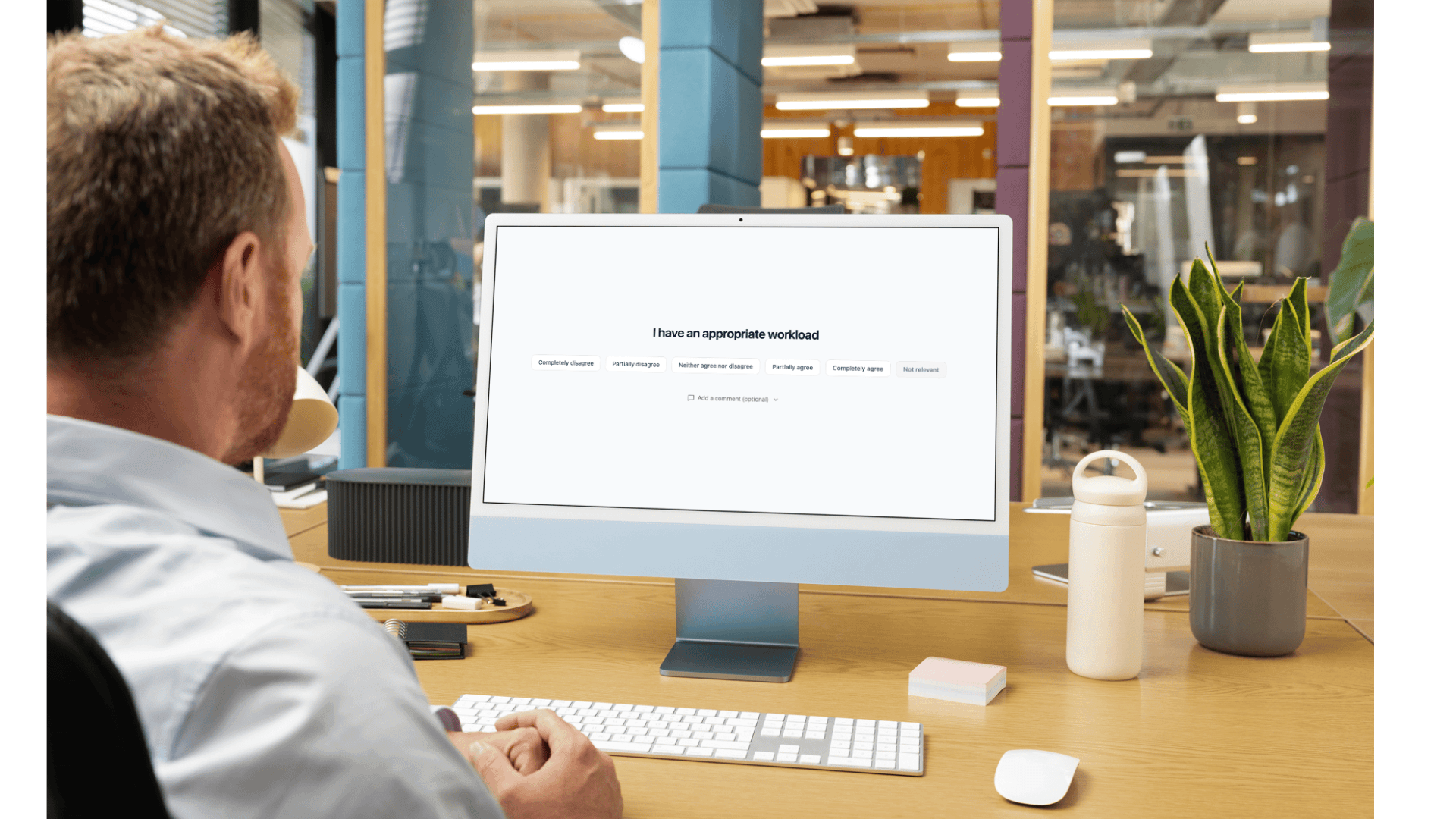
A practical method for psychosocial APV is structured statements employees respond to on a 5-point Likert scale (Strongly disagree to Strongly agree). This supports trend tracking and helps leaders interpret results without over-reading individual comments.
Quality depends on statement design:
Keep statements concrete and experience-based (not speculative).
Use clear timeframes where helpful (“In the past month…”).
Avoid double-barreled statements (“My workload is manageable and my priorities are clear”).
A large library of statements makes the platform flexible across industries and roles, but selection should be guided so surveys remain short and relevant.
Combine quantitative and qualitative inputs carefully
Open-text input can add context, but too much open-text creates workload and privacy concerns. A good digital APV often uses:
a small number of open prompts (optional),
targeted follow-up workshops where themes emerge,
and a clear process to translate themes into actions.
Build action planning into the workflow
The action plan is where compliance becomes improvement. Digital APV should make it natural to:
assign owners,
set deadlines,
log implementation steps,
schedule follow-ups,
and document evidence of effect.
Create a follow-up rhythm that employees can feel
For psychosocial topics, visible follow-up is critical. Even small changes—meeting norms, workload planning, role clarity—create credibility when communicated clearly.
A practical rhythm is:
share key outcomes quickly,
choose a small number of priorities,
implement micro-actions within weeks,
review progress on a defined schedule.
What “good APV” looks like to leaders and employees
A strong APV creates two types of clarity:
For leaders:
Where are the biggest risks?
What should we fix first?
Who owns the actions, and what is the timeline?
Are improvements working?
For employees:
Was it safe to participate?
Did leadership listen without defensiveness?
Did anything change because of our input?
When both groups get clarity, APV becomes a tool for trust and performance—not just compliance.
Conclusion
APV in Denmark is a legal requirement, but its real value is practical: it helps organizations prevent harm and improve the daily conditions that drive wellbeing, safety, and productivity. The requirements are clear—map and assess risks, incorporate sickness absence, create a written action plan, implement it, and follow up. The challenge is execution: involving employees meaningfully, keeping documentation robust, and ensuring follow-through.
A modern digital approach makes APV easier to run as a real process rather than a recurring administrative task. When structure, participation, action planning, and follow-up are built into the workflow, APV becomes what Danish regulators intended: an active tool in systematic working environment management—focused on both the physical and psychosocial work environment, and grounded in practical improvement.
References
Arbejdstilsynet. (2024, January 25). Ny bekendtgørelse om systematisk arbejdsmiljøarbejde. https://at.dk/nyheder/2024/01/ny-bekendtgoerelse-om-systematisk-arbejdsmiljoearbejde/ Arbejdstilsynet
Arbejdstilsynet. (n.d.). Arbejdspladsvurdering (APV) – krav til arbejdspladsvurderingen. https://at.dk/kend-din-rolle/arbejdsgiver/arbejdspladsvurdering/krav-til-arbejdspladsvurderingen/ Arbejdstilsynet
Arbejdstilsynet. (n.d.). Arbejdspladsvurdering (APV). https://at.dk/kend-din-rolle/arbejdsgiver/arbejdspladsvurdering/ Arbejdstilsynet
Arbejdstilsynet. (n.d.). Working Environment Act (Consolidation) – section 15a on workplace assessment (APV). https://at.dk/en/regulations/working-environment-act/ Arbejdstilsynet
Arbejdstilsynet. (2016, April). WEA Guideline D.1.1-3 on Risk Assessment (APV). https://at.dk/en/regulations/guidelines/risk-assessment-apv/ Arbejdstilsynet
Arbejdstilsynet. (n.d.). Arbejdsmiljødrøftelse. https://at.dk/kend-din-rolle/arbejdsgiver/arbejdsmiljoedroeftelse/ Arbejdstilsynet
Beskæftigelsesministeriet. (2024). Bekendtgørelse om systematisk arbejdsmiljøarbejde (BEK nr. 65 af 22/01/2024; konsolideret i retsinformation). https://www.retsinformation.dk/eli/lta/2023/1838/pdf Retsinformation
Business in Denmark (Virk). (n.d.). Mandatory risk assessment (APV) – Occupational health and safety guidance. https://businessindenmark.virk.dk/guidance/occupational-health-safety/mandatory-risk-assessment-apv/ Business in Denmark
Workplace Denmark. (n.d.). Health and safety risk assessment (APV). https://workplacedenmark.dk/health-and-safety/risk-assessment workplacedenmark.dk
Benjamiin Laudrup
CEO & Co-founder — Leadership, Psychology & Coaching
Share